

IND vs NZ 1st Test 2026 ended in a draw at the Basin Reserve in Wellington on Monday, 23 November. India declared on 720/9 after New Zealand made 368, but the hosts replied with 239/5 across 120 overs to prevent an innings defeat. Daryl Mitchell and Glenn Phillips remained unbeaten as India’s bowlers finished five wickets short of victory.
Last updated: 23 November 2026, 1:37 PM IST | Result verified against the official New Zealand Cricket scorecard.
IND vs NZ 1st Test 2026 Result: Why the Match Ended in a Draw
The final score makes the result look surprising. India piled up 720 runs, which gave Shubman Gill’s side a first-innings lead of 352. A total of that size usually creates a realistic chance to win by an innings, especially when the fielding team still has more than a day to bowl. Yet cricket is decided by wickets as well as runs, and New Zealand kept enough batters at the crease until the match was called off.
The key was New Zealand’s decision to make time, not scoring speed, the priority. They resumed Day 5 on 119/2 after 45 overs of their second innings. Across the final day they added 120 runs in 75 overs, ending at 239/5 after 120 overs overall. That distinction matters: the headline’s 120 overs refers to the whole second innings, not 120 overs bowled in a single day.
Mitchell finished on 49 not out from 186 balls and Phillips on 26 not out from 126. Their sixth-wicket association was worth 63 runs and lasted 259 deliveries. By the time the captains shook hands, there was not enough practical time left for India to remove the remaining five batters. The 1st Test was therefore drawn, not tied, abandoned or won on a first-innings lead.
IND vs NZ 1st Test 2026 Full Scorecard: India 720/9d, NZ 368 and 239/5
India won the toss and chose to bowl at the Cello Basin Reserve. The match started on Thursday, 19 November 2026 and finished on Monday, 23 November. The three innings and their durations tell the story of early damage, a huge Indian response and determined resistance on the fourth and fifth days. The IND vs NZ 1st Test 2026 scorecard below brings those phases together.
| Innings | Runs / Wickets | Overs | Key contributor |
|---|---|---|---|
| New Zealand — 1st | 368 all out | 121 | Henry Nicholls 175*; Glenn Phillips 118 |
| India — 1st | 720/9 declared | 166 | KL Rahul 136; Rishabh Pant 128 |
| New Zealand — 2nd | 239/5 | 120 | Devon Conway 65; Daryl Mitchell 49* |
| Result | Draw | — | India five wickets short |
India First-Innings Batting Summary
| Batter | Runs | Balls | Dismissal / status |
|---|---|---|---|
| Yashasvi Jaiswal | 85 | 89 | c Blundell b Henry |
| KL Rahul | 136 | 290 | b Nathan Smith |
| Devdutt Padikkal | 80 | 175 | b Jamieson |
| Shubman Gill (c) | 98 | 146 | b Duffy |
| Rishabh Pant (wk) | 128 | 153 | c Smith b Ravindra |
| Anshul Kamboj | 38 | 42 | c Conway b Phillips |
| Dhruv Jurel | 78 | 79 | st Blundell b Phillips |
| Washington Sundar | 24 | 26 | c & b Ravindra |
| Akash Deep | 13 | 5 | c Latham b Phillips |
| Jasprit Bumrah | 7* | 5 | not out |
| Prasidh Krishna | — | — | did not bat |
| Extras | 33 | — | — |
| Total | 720/9d | 166 overs | declared |
New Zealand Batting: Both Innings
| Player | First innings | Second innings | Context |
|---|---|---|---|
| Henry Nicholls | 175* | 31 | Player of the Match |
| Glenn Phillips | 118 | 26* | Two decisive batting efforts |
| Devon Conway | 4 | 65 | Second-innings resistance |
| Daryl Mitchell | 1 | 49* | Unbeaten at close |
| Rachin Ravindra | 15 | 37 | 129 balls in second innings |
| Tom Blundell (wk) | 5 | 15 | Fifth dismissal of second innings |
| Tom Latham (c) | 0 | 0 | Dismissed early in both innings |
Henry Nicholls was named Player of the Match for his unbeaten 175. He anchored New Zealand’s first innings when India had taken five quick wickets, and his partnership with Phillips ensured the match survived long enough to produce its dramatic last-day conclusion. The full ball-by-ball innings record is available in the official New Zealand Cricket scorecard.
How India Built Their Record 720/9 Declared
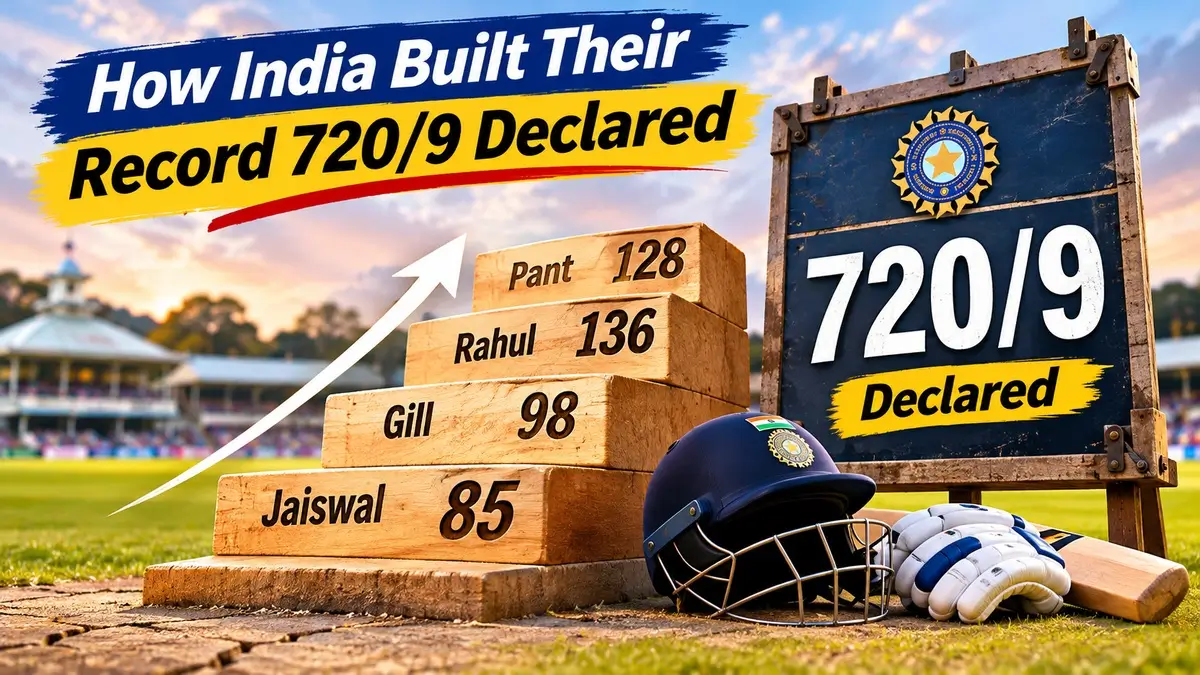
India’s innings was a collective display rather than a score built around only one double-century. Yashasvi Jaiswal set a positive tempo with 85 from 89 deliveries, while KL Rahul played a much more measured knock of 136 from 290. The pair shared an opening partnership of 130 and laid the foundation for the hours of control to follow.
Devdutt Padikkal supported Rahul with 80 from 175 balls, combining patience with selective scoring opportunities. The second-wicket stand of 165 helped make the surface look increasingly comfortable for batting. With the new ball blunted, captain Shubman Gill could work from a strong platform, contributing 98 before being bowled by Jacob Duffy.
Rishabh Pant changed the tempo with 128 from 153 balls, including six sixes. His ability to attack without losing his shape gave India a way to increase their scoring rate even after the bowlers had settled into long spells. Pant, who was the designated wicketkeeper for the match, featured in a 100-run fourth-wicket partnership with Gill.
The middle and lower order also mattered. Dhruv Jurel made 78 from 79 balls, Anshul Kamboj added 38, and Washington Sundar scored 24. These runs did not have the glamour of the centuries, but they stretched New Zealand’s fielding effort and helped India continue past 600, then 700. The innings closed at 720/9 after exactly 166 overs.
That 720 was the highest team total recorded in a Test match in New Zealand and was also India’s biggest Test innings outside India. It ranks behind India’s previous totals of 759/7 declared and 726/9 declared in the country’s all-time Test batting list. Such milestones make the lack of a victory especially striking, but they also show why simply declaring later would not automatically have guaranteed the remaining five wickets.
New Zealand did claim wickets through their slower bowlers as the innings progressed. Glenn Phillips returned 3/154, Rachin Ravindra 2/44, while Matt Henry, Kyle Jamieson, Jacob Duffy and Nathan Smith each took one. Those figures reflect how difficult the conditions had become after the opening period of seam movement.
IND vs NZ 1st Test 2026: How New Zealand Survived 120 Overs
New Zealand began their second innings with the knowledge that even reaching 300 would not be enough to make India bat again. The goal was to occupy the crease and force the clock to become India’s opponent. The hosts reached 119/2 at stumps on Sunday, having already batted for 45 overs after India declared.
Morning: Conway and Ravindra Test India’s Patience
Devon Conway resumed unbeaten on 59 and Rachin Ravindra on 27. Both had survived the early threat of the second new-ball spell, but India still needed only eight wickets at the start of the day. Washington Sundar ended Conway’s resistance for 65 when a deflection was caught by Pant. Prasidh Krishna then removed Ravindra for 37 with KL Rahul completing the catch.
At lunch New Zealand were 157/4 after 71 overs. India had added two wickets to their overnight tally, and the hosts were still 195 runs short of the visitors’ score. Daryl Mitchell and Tom Blundell now had to rebuild a very different sort of partnership: there was no realistic chase to complete, only hours to survive.
Afternoon: Blundell Falls, Mitchell and Phillips Take Charge
Anshul Kamboj dismissed Blundell for 15, with India using a successful review to confirm a faint edge behind. New Zealand were 176/5 after 77 overs, leaving India five wickets away from victory. That proved to be the decisive moment of the afternoon, because no further wicket fell.
Mitchell and Phillips began to accumulate overs rather than runs. Mitchell relied on a compact defence and judicious shot selection, while Phillips was similarly willing to leave scoring opportunities unused. Their approach was not designed to entertain with boundaries; it was an expert demonstration of how to reduce dismissal risk when the draw is the only attainable outcome.
The hosts reached tea on 206/5 after 96 overs. Mitchell was on 24 and Phillips on 19. India had achieved one wicket in the session, but the remaining time was shrinking. A relatively slow scoring rate was no problem for New Zealand because runs were not their target. The longer the pair batted, the less pressure there was to try anything adventurous.
Final Session: 63-Run Stand Ends India’s Victory Push
Mitchell and Phillips continued the same pattern after tea. Their eventual sixth-wicket stand added 63 runs from 259 deliveries, roughly 43 overs of match-saving occupation. Mitchell finished unbeaten on 49 from 186 deliveries; Phillips faced 126 balls for his unbeaten 26. Their scores were modest compared with the first-innings centuries, but their value was measured in time.
The innings finished at 239/5 after 120 overs, with the draw agreed before the scheduled close. India had tried pace, spin and part-time alternatives without breaking the partnership. Crucially, the 120 overs were split across two playing days: 45 on Day 4 and 75 on Day 5. That precise breakdown explains how an innings behind by 352 runs could still leave India without a win. The final phase of the IND vs NZ 1st Test 2026 showed how New Zealand used time and wicket preservation to protect the draw.
IND vs NZ 1st Test 2026: Major Records, Bowling Figures and Turning Points
| Metric | Figure | Why it matters |
|---|---|---|
| India total | 720/9d in 166 overs | Highest Test total on New Zealand soil |
| New Zealand 1st innings | 368 in 121 overs | Recovery from 70/5 |
| India first-innings lead | 352 runs | Pressure on the hosts |
| New Zealand 2nd innings | 239/5 in 120 overs | Kept five wickets intact |
| Mitchell–Phillips stand | 63 runs from 259 balls | Match-saving partnership |
| Player of the Match | Henry Nicholls (175*) | Anchored New Zealand’s first innings |
| WTC points | 4 each | Drawn Test result |
For India, Jasprit Bumrah’s 4/92 in New Zealand’s first innings was the standout new-ball spell. Akash Deep took 3/53 and Anshul Kamboj 2/69, while Prasidh Krishna claimed the remaining wicket. Those figures describe the help that fast bowlers found early, before the surface settled.
In New Zealand’s second innings, however, the attack produced only five dismissals from 120 overs. Krishna’s 2/23 from 19 overs was particularly economical. Bumrah took 1/42, Kamboj 1/45 and Washington Sundar 1/65; Akash Deep bowled 20 wicketless overs for 47. The balance between economical bowling and taking wickets became the central tactical issue.
Analysis: The pitch was at its most threatening in the early phase of the match. As it grew flatter, the visiting attack found it harder to create repeated chances. India’s missed opportunities and their inability to remove Mitchell or Phillips late on mattered more than the size of the lead. This is interpretation drawn from the scorecard and match reports, not a quote or a prediction.
The achievement also belonged to Nicholls and Phillips earlier in the Test. New Zealand had been reduced to 70/5 when their 216-run sixth-wicket stand rescued the first innings. Without that partnership, India would likely have reached the declaration stage much earlier and enjoyed additional bowling time. The two New Zealand rescue stands therefore influenced the result at very different moments.
Confirmed Playing XIs: India and New Zealand
These are the 22 players who actually took part in the Wellington Test, not predicted combinations from pre-match reports. Each playing XI contains exactly 11 names. Gill captained India with Pant as the designated wicketkeeper, while Latham captained New Zealand and Blundell kept wicket. Jurel played as a batter despite also being a wicketkeeper by trade.
India — Confirmed Playing XI (11 players)
New Zealand — Confirmed Playing XI (11 players)
For the wider tour context and the original fixture announcement, see the New Zealand vs India Test series schedule and squads guide. The present report uses the actual match XI and final scorecard rather than the pre-series possible selections.
What the Draw Means for the Series and the Second Test
The IND vs NZ 1st Test 2026 ended without a winner. The opening Test left the two-match contest tied at 0–0. That places considerable importance on the second and final match, which is scheduled to begin on Friday, 27 November 2026 at Hagley Oval in Christchurch. A victory there would decide the series, while another draw would leave the teams level.
The World Test Championship significance is also clear. New Zealand and India each received four points from the Wellington draw rather than the larger award available for a win. The standings change as other Tests finish, so an isolated ranking should not be treated as permanent; both countries will be looking for a stronger points return in Christchurch.
Analysis: Christchurch could reward different selection choices and bowling tactics, depending on the weather and surface at the start of the match. Neither side can assume that the pattern of Wellington will repeat. The question is whether India can turn sustained control into decisive breakthroughs, or New Zealand can produce a more balanced performance across both innings.
IND vs NZ 1st Test 2026 FAQs
Who won the IND vs NZ 1st Test 2026?
Neither team won. The first Test at Basin Reserve, Wellington, ended in a draw on 23 November 2026, with India needing five more wickets when play was called off.
How many overs did New Zealand survive?
New Zealand batted 120 overs in their second innings: 45 overs on Day 4 and 75 overs on Day 5. They finished on 239/5.
What was India’s score in the Wellington Test?
India declared their only innings at 720/9 from 166 overs. KL Rahul scored 136, Rishabh Pant made 128 and Shubman Gill contributed 98.
Who was Player of the Match?
Henry Nicholls received the award after scoring an unbeaten 175 in New Zealand’s first innings of 368. His partnership with Glenn Phillips helped the hosts recover from 70/5.
Which batters saved the match for New Zealand?
Daryl Mitchell scored 49 not out and Glenn Phillips 26 not out. Their unbroken sixth-wicket partnership added 63 runs while occupying 259 balls.
When and where is the 2nd Test?
The second Test is scheduled to start on Friday, 27 November 2026, at Hagley Oval in Christchurch. The two-match series is level 0–0.
Final Verdict: An Unforgettable Draw in Wellington
The IND vs NZ 1st Test 2026 will be remembered for two very different achievements. India showed extraordinary batting depth to reach 720/9 declared, led by Rahul and Pant, while New Zealand demonstrated that patience can be just as decisive as attacking strokeplay. The hosts never erased the first-innings deficit, yet they did enough to deny India a victory.
Mitchell and Phillips turned 259 deliveries into a match-saving partnership, Nicholls earned the Player of the Match award, and a remarkable Test finished without a winner. Fans following the series should watch the confirmed team selections and conditions ahead of Christchurch on 27 November, when both sides get one last chance to decide the contest.