

A horse racing form guide helps you understand how a horse has performed before. It brings together recent results, race conditions, distance, weight, jockey details and trainer records. The key is to look beyond a row of numbers. Compare each horse’s past races with the race it faces today, and treat every detail as evidence rather than a promise of success.
What Is a Horse Racing Form Guide?
A form guide is a record of a horse’s previous racing performances. It is often shown beside the horse’s name on a racecard. Depending on the country and provider, it may include finishing positions, dates, racecourses, distances, track conditions, weights, jockeys, trainers and ratings.
Its purpose is to help readers compare runners before a race. A horse that won last time may look strong, but that result needs context. The race may have been weaker, the distance may have suited perfectly, or the horse may now carry more weight.
How to Read Horse Racing Form Figures
Also check the number of runners in each past race. A fourth-place finish in a large, competitive field may be stronger than a fourth-place finish in a small field. The margin behind the winner can add more detail. A horse beaten by a short head may have performed much better than one beaten by several lengths.
Form figures are the short numbers and letters shown beside a runner. They summarise recent race outcomes. On common British and Irish racecards, figures are read from left to right, with the latest result usually on the right. Formats can differ between providers and countries, so always check the racecard key. If you use the Magic Win app link to access racing information, check the available racecard details and form guide to understand each runner’s recent performance.
On common British racecards, numbers from 1 to 9 show the horse’s finishing position. A 1 means first, 2 means second, and so on. A 0 commonly means the horse finished outside the first nine on British-style racecards. Letters may describe an event rather than a finishing place. These codes are most common in jump-racing form, and the exact set can vary by provider.
| Form mark | Common meaning | What to check |
|---|---|---|
| 1 | Finished first | Strength of opposition and race conditions |
| 2 | Finished second | Winning margin and how close the finish was |
| 3–9 | Finished in that position | Field size and quality of the race |
| 0 | Outside the first nine on many UK cards | Provider rules and full result |
| F | Fell | Race circumstances and jumping record |
| U / UR | Unseated rider | Where and how the incident happened |
| P / PU | Pulled up | Whether the horse stopped due to a problem or race conditions |
| BD | Brought down | Whether another runner caused the incident |
| R | Refused | Start behaviour and previous similar incidents |
Abbreviations are not universal. Check the legend on the racecard, especially when comparing UK, Irish, Indian, Australian and North American sources.
Read the full run, not just the number
Open the details behind a recent result whenever possible. Check the date, distance, surface or going, class, weight and margin from the winner. Look at the race replay or official report if the performance seems hard to judge from the figures alone.
A sequence such as 1-2-3 may look better than 4-4-5. Yet the second horse may have faced stronger fields or more suitable conditions. Recent form matters, but relevant form matters just as much.
Compare Distance, Track and Ground Conditions
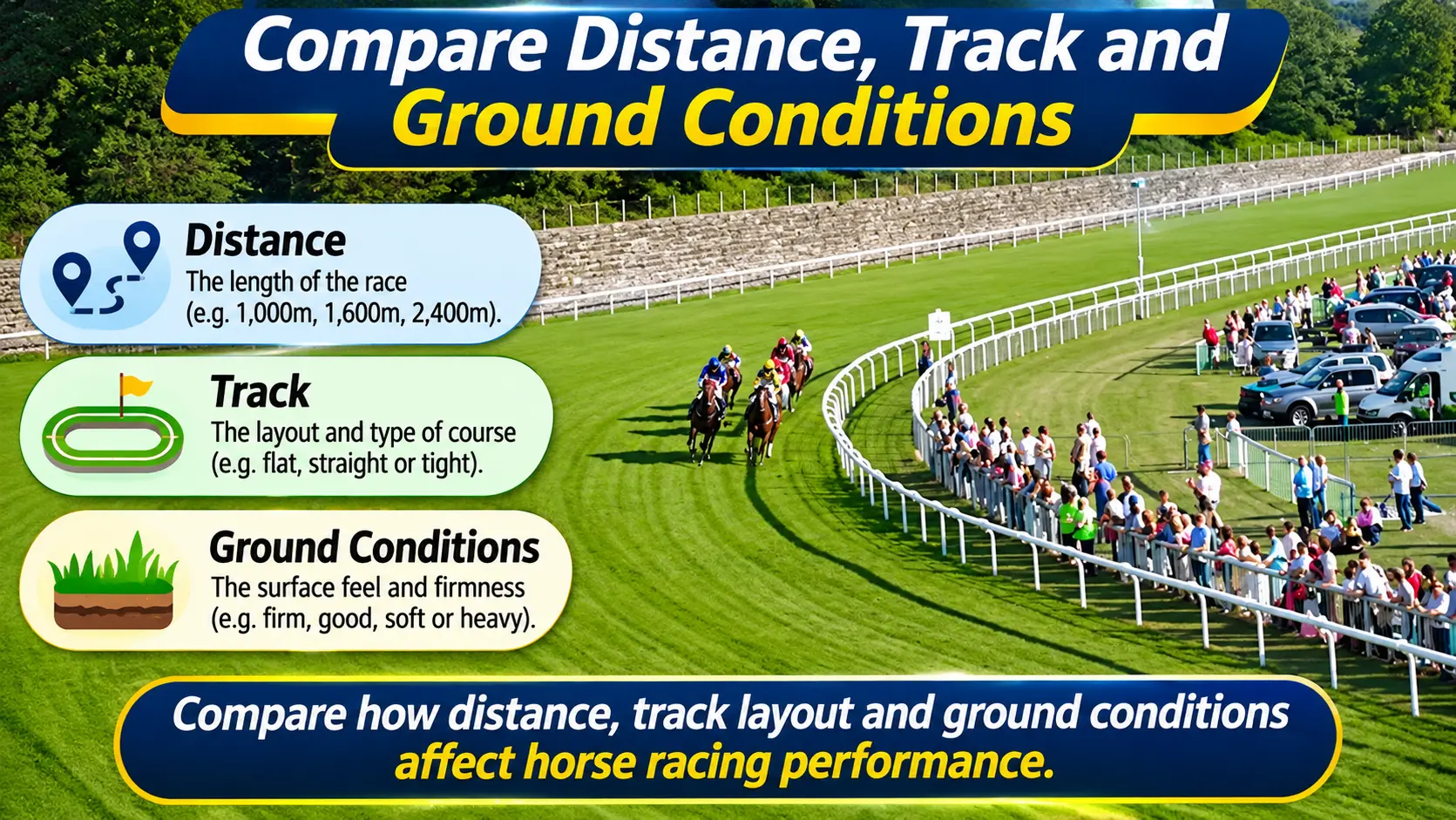
Race distance is usually shown in miles and furlongs in British and Irish racecards. One furlong is one-eighth of a mile. Other countries may use metres, so check the unit before comparing distances. A small change can still matter, especially in sprint races where early speed is important.
Pay attention to the way a horse finishes its races. A runner that stays on strongly over a longer trip may be suited by an increase in distance. A horse that leads early but fades near the finish may be better over a shorter trip. These are clues, not fixed rules, because pace and race tactics can change each time.
Horses do not all perform equally well over every distance or on every surface. Some are more effective over short trips, while others need more ground to settle and finish. A past win is most useful when the conditions are similar to today’s race.
Distance and race type
Check whether the horse has performed well over today’s distance. A horse moving up in distance may need more time to settle, while one dropping in trip may need enough early speed. Also compare the race type, such as a flat race, hurdle, steeplechase or all-weather contest. These require different skills.
Track and going
Course layout can affect a horse’s performance. Tight turns, long straights, uphill finishes and starting positions can all change how a race unfolds. In turf racing, going descriptions such as firm, good, soft and heavy describe the ground. All-weather tracks use surface-specific descriptions, which vary by venue.
Look for repeated evidence rather than one result. If a horse has several strong runs on soft ground, that may be useful when similar conditions are expected. One poor run on a different surface should not automatically define its ability.
Understand Weight, Ratings and Handicaps
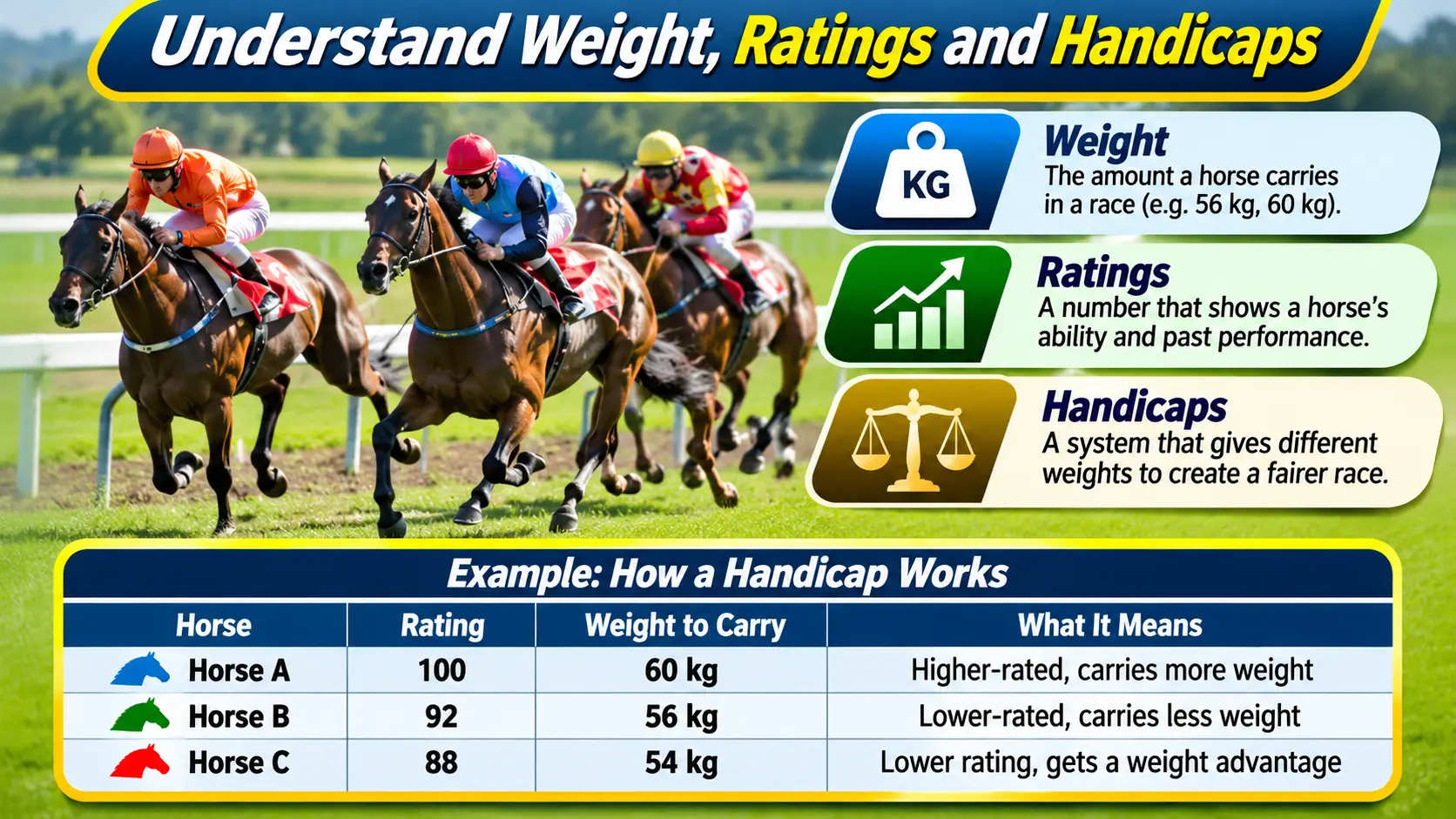
Weight is usually shown in stones and pounds on many British and Irish racecards, while other countries may use kilograms. Make sure you are comparing like with like. A horse carrying more weight than last time may face a tougher task, but its latest performance and the strength of the field also matter.
In handicap races, the rating is one part of the system used to set the weight. A horse may rise in the ratings after a strong win, which can lead to a higher weight in a later race. A lower rating may make the horse more competitive on paper, but it does not prove that the horse is ready to improve.
Check for apprentice or other weight allowances where the race rules permit them. Also look for penalties that may apply after a recent win. The final weight shown on the official racecard is more useful than an estimate. If the race conditions are unclear, use the official race authority’s published information.
Weight is an important part of many racecards. In a handicap race, horses carry different weights based on their official ratings and the race conditions. The aim is to bring runners of different ability levels closer together. A higher-rated horse will generally carry more weight than a lower-rated horse.
For example, the British Horseracing Authority explains that a 10-point rating gap can create a 10-pound difference in the weight carried in its handicap example. Actual weights can also be affected by minimum weights, allowances, penalties and the conditions of the race.
An official rating is not a prediction of the result. It is an assessment used within the racing system. Compare a horse’s rating with its recent performances and the ratings of its rivals. Also check whether the horse has been raised after a win or has dropped in the ratings after weaker results.
Read the British Horseracing Authority’s guide to handicapping for an explanation of how ratings are assessed and used in British racing. Rules and rating systems differ across countries, so use the relevant racing authority for local races.
How a British handicap rating difference relates to weight
BHA scale illustration: each rating point represents one pound (0.45 kg) in the BHA handicap framework. The example below is illustrative, not a real race or named horse.
A three-point rating gap represents a theoretical three-pound weight difference in the BHA example. Actual race weights depend on race conditions, minimum weights, penalties and allowances.
Assess Jockey and Trainer Records
When you review statistics, note the time period and number of rides. A jockey with four wins from ten rides has a 40% strike rate, but ten rides is a small sample. A jockey with 30 wins from 200 rides has a lower percentage, yet the larger sample may offer a more stable picture. Neither figure should be read without context.
The jockey and trainer can add useful context to a horse’s form. A jockey’s experience, riding style and familiarity with a horse may matter. A trainer’s record can show how well a stable has prepared runners for certain race types or conditions.
What to check about a jockey
Look at recent rides, wins, places and the type of races involved. A high win percentage can be useful, but it may come from a small number of rides or from stronger horses. Check the jockey’s record at the course and over the distance when reliable figures are available.
Also consider whether the jockey has ridden the horse before. Familiarity can help, but it does not guarantee a better result. A new jockey may also suit a horse’s running style or be following the trainer’s instructions.
What to check about a trainer
Review the trainer’s recent results and performance with similar runners. Some trainers have stronger records with young horses, sprinters, stayers or jump racing. Stable form can change, so use a clear time period and avoid drawing a conclusion from only one or two races.
Horse racing form analysis: four-step workflow
Use this sequence to review each runner consistently. It is a practical checklist, not a scoring model.
Use a Simple Step-by-Step Form Analysis
Once you have gathered the details, compare the runners against the same questions. Avoid changing your method because one horse has a famous name or an impressive-looking last result. A simple notes table can help you record the evidence and identify where information is missing.
| Factor | Question to ask | Why it matters |
|---|---|---|
| Recent form | Are the latest runs consistent and competitive? | Shows recent performance patterns |
| Distance | Has the horse performed well over this trip? | Helps assess stamina or speed needs |
| Going or surface | Has it handled similar conditions? | Past performance may vary by surface |
| Weight and rating | Has the handicap mark or carried weight changed? | Shows a change in the task |
| Jockey and trainer | Are the records relevant and based on enough runs? | Adds context to the horse’s own form |
Do not try to turn this table into a guaranteed scoring system. Different races place different demands on horses. A runner’s suitability for the distance and ground may matter more than a general win percentage. Use the checklist to organise your thinking, not to create false certainty.
A consistent method makes racecard analysis easier. Review every runner in the same order instead of focusing only on familiar names or recent winners. This helps you notice important details and compare horses fairly.
- Read the race conditions, distance, race type and expected surface.
- Check the latest form figures and open the details of recent runs.
- Compare the horse’s past results at a similar distance and track.
- Review ground or surface preferences and likely race conditions.
- Check weight, official rating, allowances and any penalties.
- Review jockey and trainer records over a relevant sample.
- Consider field size, draw where relevant, pace and likely race position.
- Compare the evidence across all runners and note what remains uncertain.
Example: comparing two runners
Imagine Runner A won its latest race but steps up in distance today. Runner B finished third last time but has already performed well over today’s trip and on similar ground. Runner A has the better recent finishing position, but Runner B may have more relevant evidence for this race.
This is an example, not a real race prediction. It shows why the latest result should not be used alone. The full record, race conditions and quality of opposition help explain what a result means.
Common Mistakes When Analysing Horse Racing Form
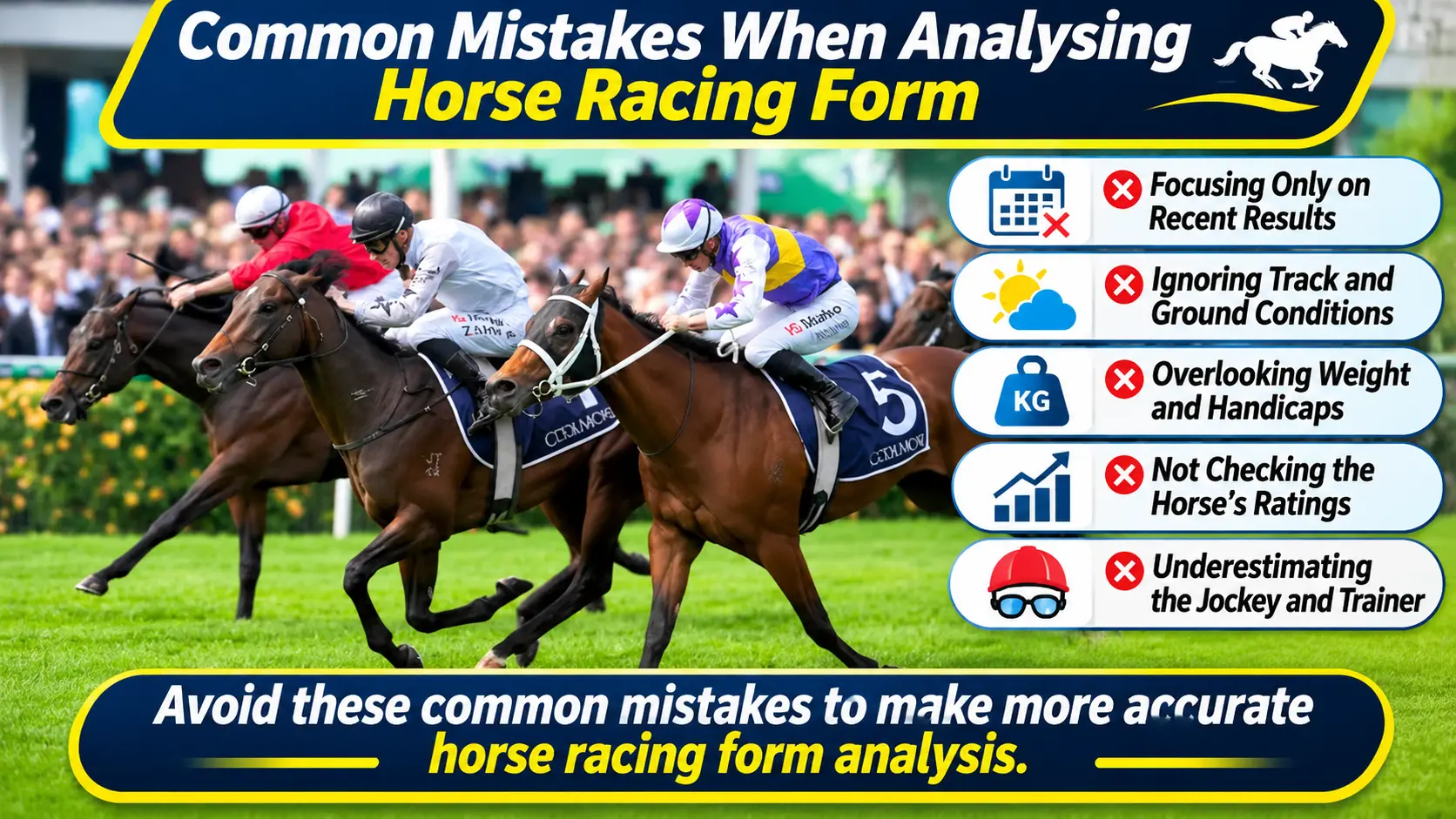
Another mistake is comparing statistics from different sources without checking how they are calculated. One provider may count all-weather races separately, while another may group them differently. Some records include only a selected date range. Use the same source and definition when making a direct comparison.
Do not overlook non-runners and late changes. A withdrawn horse can affect the pace and shape of a race. A change in jockey, equipment or declared conditions may also be shown in official updates. Check the latest race information close to the event rather than relying only on an older form guide.
One common mistake is choosing a horse only because it won its last race. That win may have come in a weaker field or under conditions that will not apply today. Another mistake is ignoring the weight a horse must carry after its rating changes.
Do not treat a fall, pulled-up run or poor finish as proof that a horse has lost its ability. Find out what happened and look for reliable information. Equally, do not assume an incident was harmless without evidence.
Finally, remember that form guides cannot remove uncertainty. Horses can be affected by health, pace, weather, track changes, interference and many other factors. If you use form when considering betting, set limits and never treat analysis as a way to guarantee a return.
Frequently Asked Questions
1. What is a horse racing form guide?
It is a summary of a horse’s previous races. It can include finishing positions, dates, distances, conditions, weights, jockeys, trainers and ratings.
2. How do you read horse racing form figures?
Figures show recent finishing positions, while letters can show events such as a fall or pulled-up run. The order differs by country and provider, so check the racecard key.
3. What does a 0 mean in horse racing form?
On many British-style racecards, 0 means the horse finished outside the first nine. Always check the rules used by the form provider.
4. Why are jockey and trainer records important?
They provide extra context about experience and recent performance. Compare relevant races and sample sizes rather than relying on a single percentage.
5. What is an official rating in horse racing?
It is an assessment of a horse’s ability made by a racing authority. In handicaps, it helps determine the weight carried, subject to race rules and allowances.
6. Can a horse racing form guide predict the winner?
No. It helps compare past performances, but conditions, fitness, pace, competition and chance can all affect the result.
Conclusion
A horse racing form guide is most useful when you read it as a complete record, not a list of finishing positions. Start with recent runs, then compare distance, track, ground, weight and the quality of opposition. Review jockey and trainer details to add context, not to replace the horse’s own record.
Use the same checklist for every runner and be clear about what the evidence can and cannot tell you. A careful review can make racecards easier to understand, but it cannot guarantee a result. The strongest analysis is balanced, evidence-led and honest about uncertainty.