

Quick preview: New Zealand host India in the fifth and final ODI at Bay Oval, Mount Maunganui, on Sunday, 15 November 2026. India lead the series 2-1 after the first two wins and a no-result third match, while New Zealand enter the finale after a 244-run victory in the fourth ODI. The match begins at 7:30 AM IST (3:00 PM local time).
The five-match series reaches its final day with India already assured of avoiding a series defeat, but the teams have plenty to play for. New Zealand can level the contest at 2-2 with another win, while India will want to finish the tour’s ODI leg with a stronger performance after their heavy loss in the previous game.
The New Zealand vs India 5th ODI 2026 is set to be played at Bay Oval, the same venue where the hosts produced a commanding performance in the fourth match. That result has changed the mood around the series: New Zealand’s fast bowlers found movement and bounce, and their batters made the most of the conditions. India, meanwhile, must respond with better discipline at the top of the order.
This preview covers the confirmed match information, latest available squads, selection questions, venue conditions, players to watch and a measured match prediction. Probable combinations are not official team announcements and will remain subject to the toss.
New Zealand vs India 5th ODI 2026: Match Details
The final match is scheduled as a day-night ODI at Bay Oval in Mount Maunganui. The official schedule lists a 3:00 PM local start, which converts to 7:30 AM Indian Standard Time. The fifth ODI is part of India’s 2026 tour of New Zealand.
| Match information | Details |
|---|---|
| Match | New Zealand vs India, 5th ODI |
| Date | Sunday, 15 November 2026 |
| Start time | 7:30 AM IST |
| Local start time | 3:00 PM NZDT |
| Venue | Bay Oval, Mount Maunganui |
| Series | India tour of New Zealand 2026 |
| Series position | India lead 2-1; one match was a no-result |
| Format | One Day International |
| Match status | Upcoming at the time of publication |
India’s lead means New Zealand need a win to finish level. For India, the immediate priority is to restore confidence in the batting unit and avoid another early collapse. The result will also provide both teams with a final look at their 50-over combinations before attention shifts to the next part of the international calendar.
Series Recap: How the Teams Reached the Final ODI
India won the opening two matches, both affected by the weather and decided under the Duckworth-Lewis-Stern method. The third ODI in Hamilton did not produce a result. New Zealand then delivered a major response in the fourth match at Bay Oval, winning by 244 runs after scoring 333 and dismissing India for 89.
| Match | Venue | Result |
|---|---|---|
| 1st ODI – 4 November | Eden Park, Auckland | India won by 5 wickets (DLS) |
| 2nd ODI – 7 November | Hnry Stadium, Wellington | India won by 4 runs (DLS) |
| 3rd ODI – 10 November | Seddon Park, Hamilton | No result |
| 4th ODI – 13 November | Bay Oval, Mount Maunganui | New Zealand won by 244 runs |
| 5th ODI – 15 November | Bay Oval, Mount Maunganui | Upcoming |
Series Position Before the Final ODI
India lead 2–1, with one match ending without a result.
One additional match was a no-result and is not counted as a win for either team.
Fourth ODI: Runs Comparison
New Zealand set 333 runs; India were bowled out for 89.
The bars use the same scale, with New Zealand’s total set to 100%.
Fourth ODI: Standout Individual Performances
The two headline contributions that shaped the 244-run result.
Runs and wickets are different measures; the bar lengths are illustrative only and are not a direct statistical comparison.
The fourth ODI was defined by two standout performances. Will Young made 125 from 108 balls to anchor New Zealand’s innings, while Matt Henry claimed 6 for 27 as India were bowled out for 89 in 26.4 overs. Henry’s opening over removed three Indian batters, putting the visitors under immediate pressure.
That defeat should not erase India’s earlier work in the series, but it does underline the importance of a more assured start. The top order must leave well, play late and avoid chasing deliveries outside the off stump. New Zealand will look to repeat the accuracy and attacking lengths that brought them success.
Latest Squads for New Zealand vs India 5th ODI 2026
Squad information changed during the tour, so the final-match lists below reflect the latest available team announcements rather than the original tour squads. New Zealand Cricket announced further additions for the fifth ODI on 12 November, including Brett Randell and Josh Clarkson. India’s announced squad for the fourth and fifth ODIs is listed by the BCCI.
India squad – fourth and fifth ODIs
New Zealand squad – fifth ODI
Squad clarification: Brett Randell is a potential international debutant. Josh Clarkson was added specifically for the fifth ODI. Do not treat either team’s squad list as its confirmed playing XI; the final XI is announced at the toss.
For India, the key leadership change from the opening matches is already clear: Shreyas Iyer captains the side for the final two ODIs, with Ishan Kishan named vice-captain and wicketkeeper. The squad includes several batting options, two specialist wicketkeepers and a varied bowling group. The team management must decide how to balance batting depth with enough pace and spin options for Bay Oval. Fans following cricket updates and match action through the Magic Win app could also explore the latest match coverage and cricket insights.
New Zealand’s final-match group has a different shape from its earlier squad. The late additions provide extra options, while the listed group includes multiple seam-bowling choices and wicketkeeping cover. The hosts will need to select a combination that can make early use of the conditions without leaving the middle order short of batting depth.
Probable Playing XI and Selection Questions
The playing XIs are not confirmed before the toss. Any preview combination should therefore be treated as an informed possibility, not an official team announcement. Selection may also depend on fitness, workload and the surface prepared for the final match.
India: likely combination
India could build around Rohit Sharma and Ruturaj Gaikwad at the top, followed by Virat Kohli and captain Shreyas Iyer. Ishan Kishan offers a left-handed wicketkeeping option, while Axar Patel and Naman Dhir can add batting depth. The remaining places are likely to be shared among specialist bowlers and an additional all-round option.
A possible structure is: Rohit Sharma, Ruturaj Gaikwad, Virat Kohli, Shreyas Iyer (captain), Ishan Kishan (wicketkeeper), Axar Patel, Naman Dhir, Kuldeep Yadav, Mohammed Siraj, Arshdeep Singh and one of the remaining pace or all-round options. This is a projection only; the exact balance could change at the toss.
New Zealand: likely combination
New Zealand can consider Finn Allen as an attacking opener, with Tim Seifert or Mitch Hay providing wicketkeeping options. Will Young and Nick Kelly offer top- and middle-order stability, while Michael Bracewell, Dean Foxcroft and captain Mitchell Santner provide flexibility. The bowling mix can be selected from the available seamers and spin options.
A possible structure is: Finn Allen, Tim Seifert (wicketkeeper), Will Young, Nick Kelly, Dean Foxcroft, Michael Bracewell, Mitchell Santner (captain), Kristian Clarke, Jacob Duffy, Matt Fisher and Blair Tickner. Josh Clarkson and Brett Randell are also in the final-match squad and could come into consideration. This is not a confirmed XI.
The key selection question for India is whether to prioritise an extra batter or a deeper bowling attack. For New Zealand, the selectors must decide how much pace to use and whether the conditions justify an additional seam option. Both decisions will become clearer at the toss.
Bay Oval Pitch Report and Match Conditions

Bay Oval is generally regarded as a good venue for stroke-making, with a quick outfield and enough pace for batters who time the ball well. It can also offer seam movement and bounce, particularly when the ball is new and conditions are favourable to fast bowlers. The fourth ODI demonstrated both sides of the surface: New Zealand made 333, but India’s innings unravelled against accurate pace bowling.
| Pitch factor | What teams should expect |
|---|---|
| Batting | Good scoring opportunities once batters are set |
| New-ball bowling | Seam movement may be available early |
| Bounce | Can assist quick bowlers who hit a hard length |
| Spin | May become useful as the innings progresses |
| Outfield | Generally quick, rewarding well-timed shots |
| Key batting approach | Build partnerships and avoid risky early drives |
The fourth-match score is useful context, but one innings should not be treated as a guaranteed forecast for the next game. A total of 333 showed that the surface can support substantial scoring. India’s collapse, meanwhile, was heavily influenced by the quality of New Zealand’s bowling and the loss of three wickets in the opening over.
For the team batting first, a steady powerplay and wickets in hand will be important. The side chasing should avoid allowing the required rate to dictate reckless shots early. A first-innings score in the high 200s could be competitive, but the expected total will depend on the actual pitch, weather and match tempo. It would be misleading to present a fixed par score as certain.
Mount Maunganui Weather and Toss Factors
The match is scheduled for the afternoon in New Zealand, beginning at 3:00 PM local time. Coastal weather can change, and wind or cloud cover may influence how the ball behaves. A verified, match-day forecast should be checked closer to the start; a precise temperature or rain percentage should not be guessed in advance.
If there is cloud cover or a breeze, the seamers may find assistance with the new ball. Captains will also consider whether the surface looks better for batting first or whether chasing could become easier under lights. The toss will matter, but it should not outweigh the need for disciplined execution.
| Weather and toss detail | Information |
|---|---|
| Venue | Bay Oval, Mount Maunganui |
| Match date | 15 November 2026 |
| Local start | 3:00 PM NZDT |
| India start | 7:30 AM IST |
| Forecast status | Check the latest local forecast on match day |
| Potential influence | Cloud, breeze and any interruption could affect tactics |
Players to Watch in the Fifth ODI
Rohit Sharma – India
Rohit Sharma’s ability to put pressure on the new-ball attack makes him a major figure in India’s plans. The opening overs at Bay Oval may offer movement, so his judgement outside off stump and ability to score without taking unnecessary risks will be important. A positive start from Rohit can give the middle order a platform.
Virat Kohli – India
Virat Kohli is central to India’s plans through the middle overs. He can rotate the strike, target gaps and build an innings around partnerships. Against New Zealand’s seamers, his ability to manage the early phase before accelerating could prove valuable.
Shreyas Iyer – India
As captain for the final two ODIs, Shreyas Iyer has both leadership and batting responsibilities. India need composure after the fourth-match collapse, and Iyer’s role in organising the middle order will be important. He will also have to make clear decisions about how aggressively to approach the powerplay and middle overs.
Matt Henry’s absence from the fifth-match squad – New Zealand
Matt Henry’s 6 for 27 in the fourth ODI was decisive, but the latest New Zealand Cricket squad announcement for the fifth match does not list him in the final-match group. That is an important distinction for readers: his fourth-ODI performance is relevant context, but he should not be described as a confirmed selection for the fifth ODI. New Zealand’s other seamers will need to provide the early pressure.
Will Young – New Zealand
Will Young’s 125 from 108 balls was the defining batting contribution in the fourth ODI. He showed that patience and well-timed attacking shots can work at Bay Oval. If he carries that confidence into the final match, India will need to remove him before he settles into another long innings.
Mitchell Santner – New Zealand
Mitchell Santner’s captaincy and all-round skills give New Zealand flexibility. He can manage the bowling resources, provide control through spin and contribute useful runs lower down the order. His tactical choices will be important if India build a partnership in the middle overs.
India vs New Zealand ODI Head-to-Head Context
India and New Zealand have a long ODI rivalry, with India holding the stronger overall record in the historical figures available before this series. However, the record at home in New Zealand has been more challenging for India, making venue conditions a relevant part of the preview.
Published pre-series summaries have listed 123 previous ODIs, with India winning 63, New Zealand 52, one match tied and seven ending without a result. Those figures pre-date the five-match 2026 series and should not be presented as a live, updated total for the eve of the fifth ODI. Because four matches in the current series have now been played, a fresh all-time tally should be confirmed from a current statistical database before publication. This article avoids presenting an outdated total as current.
The broader lesson is that historical records provide context, not a prediction. New Zealand’s home conditions and the recent fourth-ODI performance make the hosts dangerous, while India’s earlier wins show that the visitors have already found ways to compete in this series.
New Zealand vs India 5th ODI 2026 Match Prediction
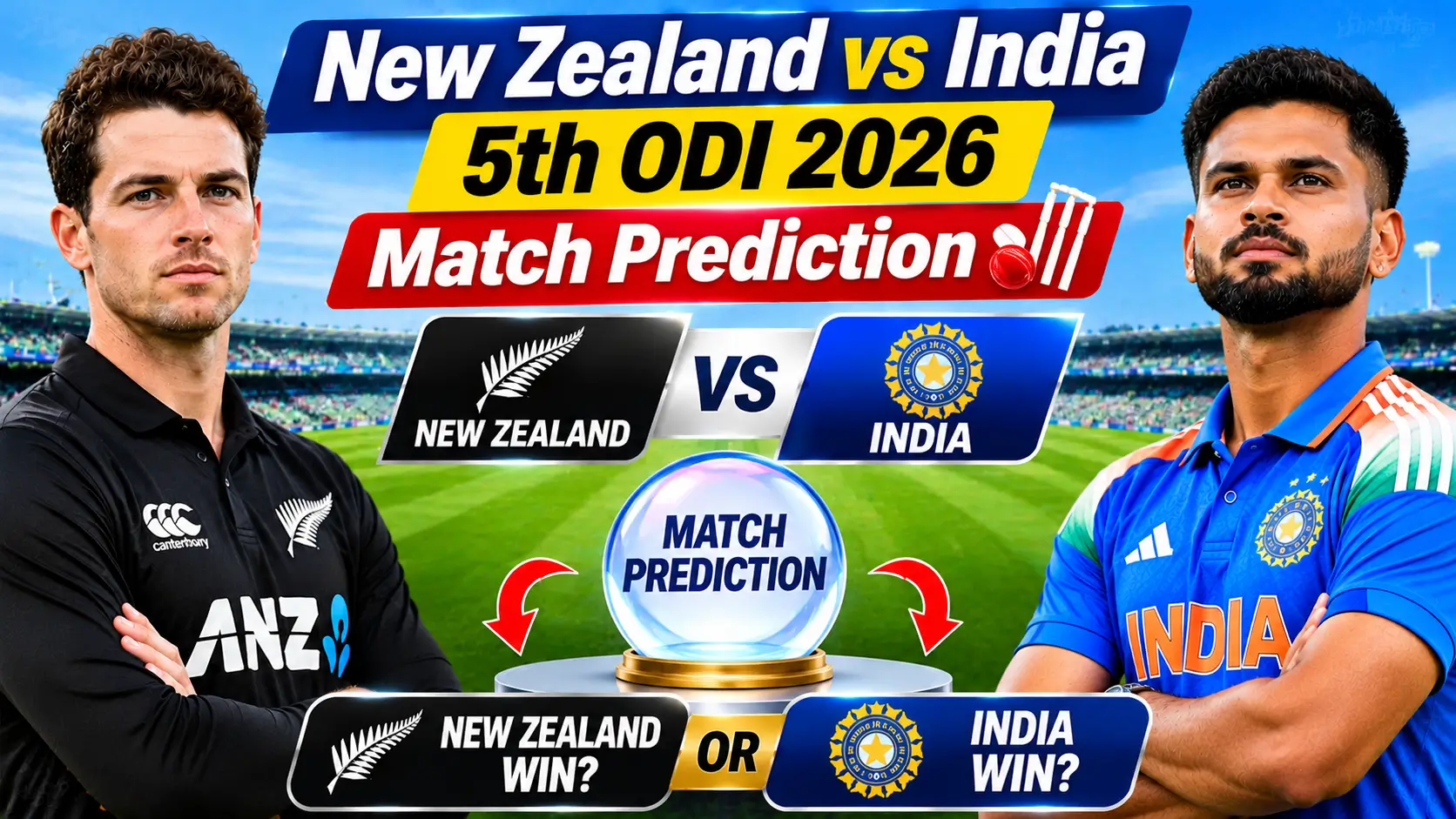
The final match looks more evenly balanced than the series score alone might suggest. India lead 2-1 and have already secured at least a share of the series, but New Zealand’s 244-run win in the fourth ODI will give the hosts confidence. The same venue also means the visitors must quickly adapt to the conditions that troubled them in the previous match.
India’s advantage is the experience and depth of their batting group. Rohit Sharma, Virat Kohli and Shreyas Iyer can all shape an innings, while Axar Patel offers balance. Their challenge is to survive the first spell and avoid losing multiple wickets before the innings has settled. For the official match report and tournament context, see the BCCI official website.
New Zealand’s case rests on home conditions, recent momentum and a flexible squad. Will Young is coming off a century, and the hosts have several pace options to test India’s technique. The latest squad changes mean the attack will not necessarily be the same as the one that played the fourth ODI, so New Zealand must find a new combination capable of maintaining pressure.
Prediction: India have a narrow edge because of their stronger batting experience and series position, but New Zealand are well placed to challenge them at Bay Oval. The toss, the first ten overs and the ability to protect wickets will be decisive. This is a match assessment, not a certainty or a guarantee of the result.
Where to Follow the Match and Final Thoughts
Indian viewers should check the latest television and streaming schedules for the official broadcast details before the match. Fans following Magic Win cricket updates can also keep track of match coverage and related cricket insights. Live score updates, the toss, confirmed playing XIs and any last-minute team changes should be checked on match day. The official playing XIs will only be known once the toss has taken place.
The New Zealand vs India 5th ODI 2026 offers a meaningful finish to a competitive series. India will want a disciplined response after the fourth ODI, while New Zealand have a chance to level the series and carry momentum forward. The pitch may offer something for both batters and seamers, so the team that handles the opening phase best could gain the advantage.
For India, the focus should be on a composed start, strong partnerships and smarter shot selection. For New Zealand, the challenge is to use home conditions without allowing the visitors’ experienced batters to dictate the middle overs. The final result will depend on execution rather than reputation alone.
Frequently Asked Questions
1. When is New Zealand vs India 5th ODI 2026?
The fifth ODI is scheduled for Sunday, 15 November 2026. It begins at 7:30 AM IST, which is 3:00 PM local time in New Zealand.
2. Where will the fifth ODI between New Zealand and India be played?
The match will be played at Bay Oval in Mount Maunganui, New Zealand. It is the same venue that hosted the fourth ODI.
3. Who is captaining India in the final ODI?
Shreyas Iyer is the captain of India for the fourth and fifth ODIs. Ishan Kishan has been named vice-captain and wicketkeeper in the squad announcement.
4. Who is the captain of New Zealand?
Mitchell Santner is leading New Zealand in the ODI series. He is also listed as captain in the latest fifth-match squad update.
5. What is the pitch like at Bay Oval?
Bay Oval generally offers good batting conditions, a quick outfield and opportunities for seamers, particularly with the new ball. The fourth ODI showed that disciplined fast bowling can still make batting difficult.
6. Who is favourite to win the fifth ODI?
India have a narrow edge on paper because they lead the series and have an experienced batting lineup. New Zealand remain strong contenders after their emphatic fourth-ODI victory at the same venue.