
 Updated: 3 November 2026 · India vs New Zealand ODI Series
India vs New Zealand ODI Squad 2026 details are especially important for fans following the five-match series in New Zealand from November 4 to November 15. India have named different groups for the opening three matches and the final two, while New Zealand have also adjusted their squad around injuries and the approaching Test series. Here is the confirmed picture as of November 3, 2026, with the captains, full player lists, schedule, and what the selections mean.
Quick answer: Shubman Gill captains India in the first three ODIs against New Zealand on November 4, 7 and 10, with Shreyas Iyer leading the final two on November 13 and 15. Mitchell Santner captains New Zealand throughout. Rohit Sharma and Virat Kohli are selected for all five games, subject to match-day selection.
The series begins at Eden Park in Auckland on Wednesday, November 4, at 7:30 AM IST. Importantly, this is India’s November tour of New Zealand, not the separate three-match series played in India in January 2026.
India vs New Zealand ODI Squad 2026: Official India Player Lists
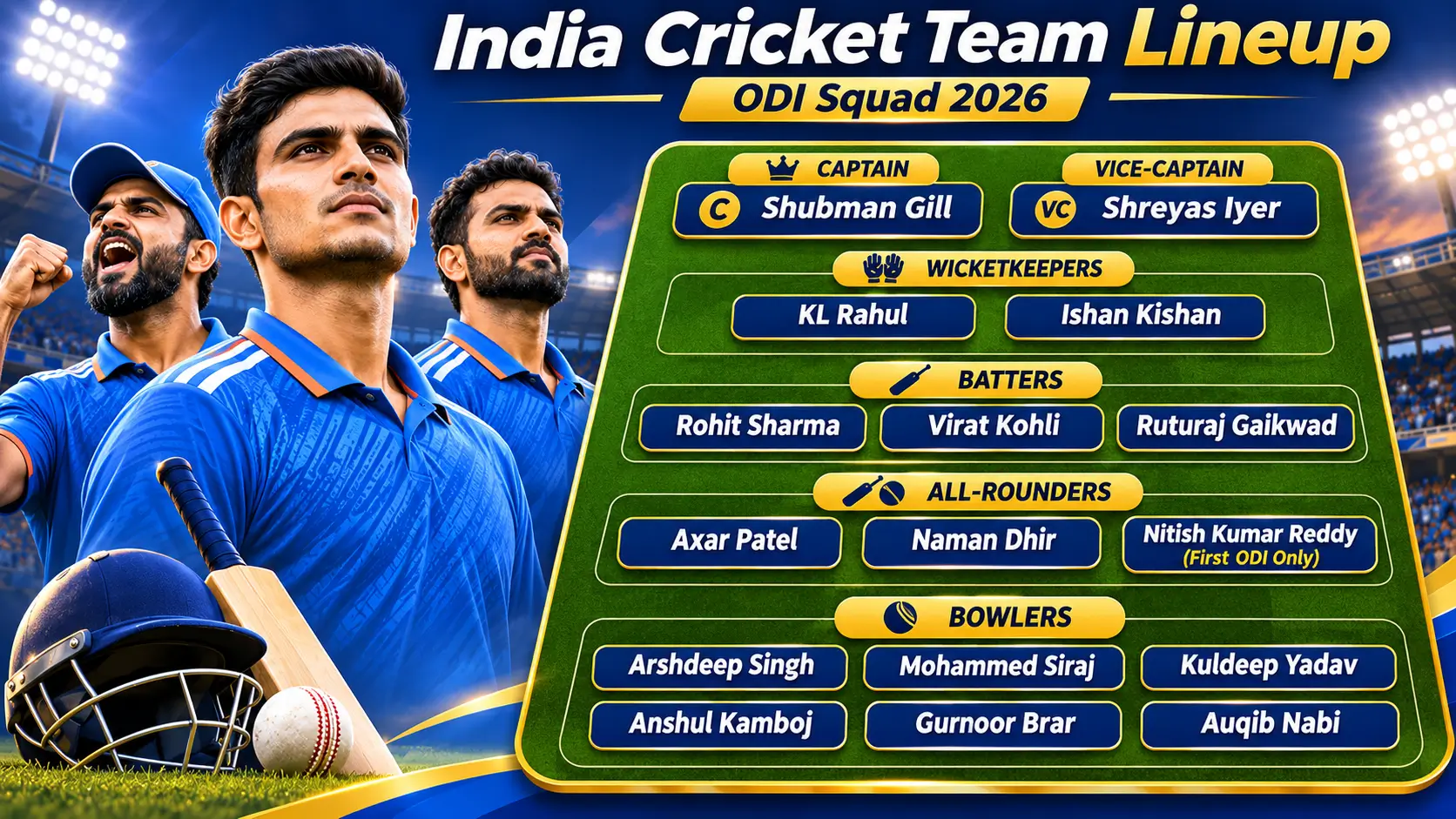
India squad for the first three ODIs
This is the latest BCCI list following the October 30 and October 31 amendments. It contains 16 names for the opening match, but Reddy’s availability is specifically restricted to the first ODI. The squad for matches two and three therefore should not simply be copied from the first-match roster without that qualification.
Gill’s presence provides a clear captain at the top, while Rohit and Kohli bring an established batting core. Rahul and Kishan give the management two named wicketkeeping choices. The bowling options include left-arm pace through Arshdeep, right-arm seam through Siraj and several alternatives, with Kuldeep supplying wrist-spin variety.
India squad for the fourth and fifth ODIs
The final two-match group has 15 players. Iyer becomes captain, Kishan takes the vice-captaincy, and Tilak Varma, Kumar Kushagra and Yash Thakur feature in this phase. Gill and Rahul are absent from the later ODI list; that is an announced squad arrangement, not evidence of a new injury.
New Zealand ODI Squad: Two Groups Under Mitchell Santner
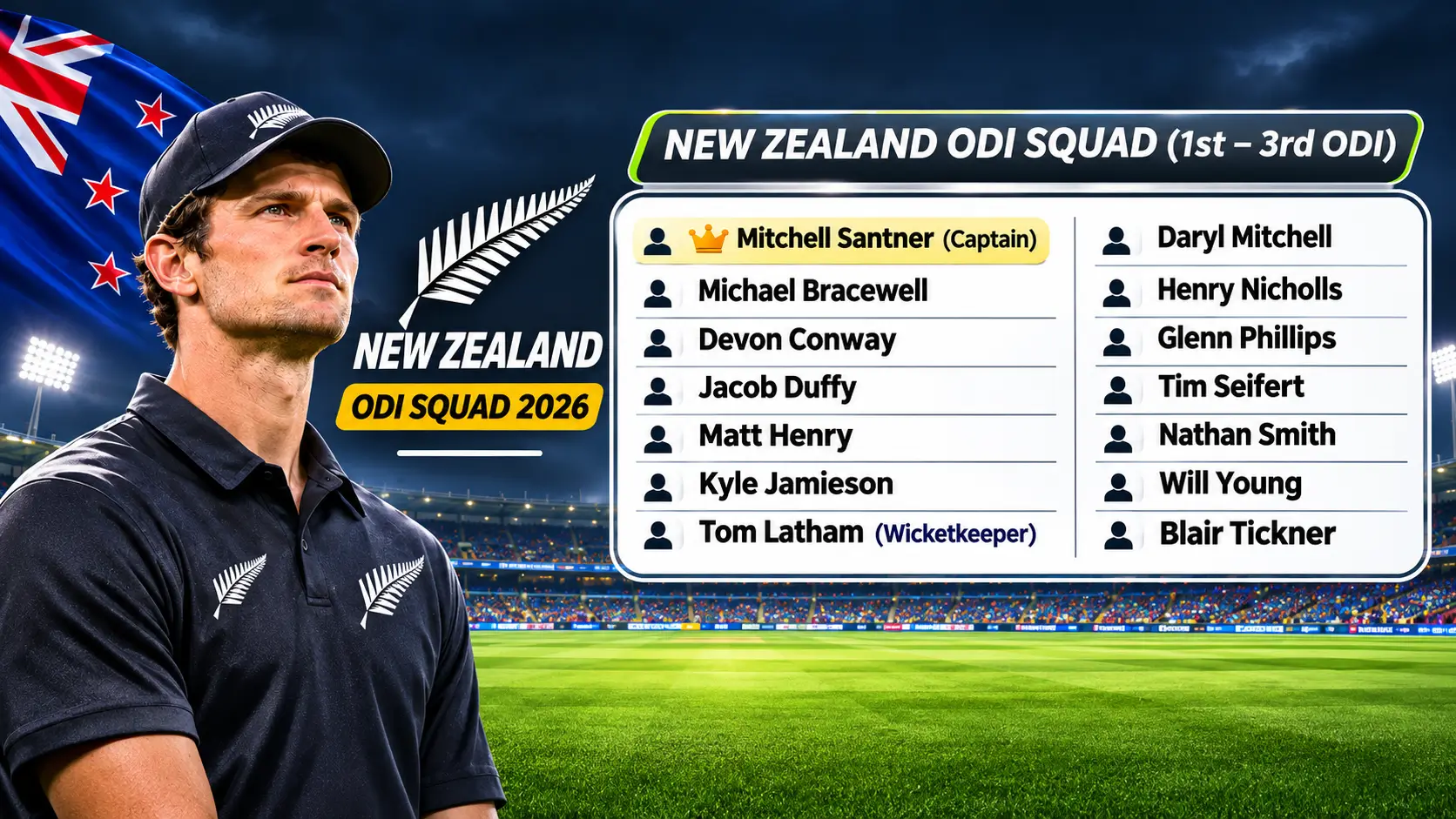
New Zealand squad for ODIs one to three
This 14-player list is New Zealand Cricket’s updated squad published on November 2. It replaces earlier versions that included Rachin Ravindra and Mark Chapman. Matt Fisher is also travelling with the squad as an additional bowling option, although he is not listed among these 14 names in the official first-three-match roster.
New Zealand’s early-series group combines established middle-order options with seam-bowling depth. Conway and Young are among the batting choices, while Latham and Seifert provide wicketkeeping options. Santner and Bracewell offer spin and lower-order balance. Exact batting positions will depend on the match-day XI.
New Zealand squad for ODIs four and five
The 13-player final-phase squad brings in Allen, Ferguson and several other names while some players preparing for red-ball cricket leave the ODI group. Mitchell Santner remains captain throughout, avoiding the leadership handover seen in India’s squad.
Latest Squad Changes, Injuries and Selection Clarifications
Why is Prasidh Krishna missing?
Prasidh Krishna appeared in India’s initial announcement on October 16, subject to fitness clearance. On October 30 the BCCI said he was ruled out of the ODI series while recovering from a hamstring injury. The October 31 update then added Auqib Nabi to the first three ODIs; Nabi had already been selected for the final two.
That sequence explains why some older squad articles still list Krishna. For publication on November 3, the amended BCCI list takes precedence over the original announcement. An injury withdrawal should never be silently presented as a tactical omission.
What happens to Nitish Kumar Reddy?
The BCCI’s latest squad announcement limits Nitish Kumar Reddy to the first ODI on November 4. He is then scheduled to link up with India A for match practice before the subsequent Test series. He is not on the official fourth-and-fifth-ODI list either.
Why are Ravindra and Chapman absent for New Zealand?
New Zealand Cricket confirmed on November 2 that Mark Chapman has a hamstring issue and Rachin Ravindra is recovering from a shoulder problem. Neither will take part in this ODI series. Henry Nicholls was called in for the first three games, while Dean Foxcroft joined the final-two-match group.
Tim Seifert, originally chosen for the final two games only, is now available across the series. NZC also said Matt Henry would be assessed for readiness, and Fisher would remain with the group as extra seam cover. Those details are more current than the initial New Zealand selection announcement.
Captains, Wicketkeepers and Key Player Roles
Why are Gill and Iyer sharing India’s captaincy?
The official plan gives Shubman Gill ODIs one to three and Shreyas Iyer ODIs four and five. The BCCI has confirmed the arrangement, but has not presented it as a referendum on either player’s permanent ODI captaincy. It is more accurate to describe a scheduled change of leadership than to speculate about dressing-room decisions.
Iyer is vice-captain in the opening phase; Kishan becomes vice-captain in the last two.
Which players shape India’s batting and bowling balance?
Rohit and Kohli remain major batting names, but selection does not guarantee either a particular batting position or a start in every match. Gill and Iyer will be especially important in managing batting decisions during their respective captaincy periods.
Kishan appears in both groups and provides wicketkeeping flexibility. Rahul is listed for the first three ODIs, while Kushagra joins the final two. On the bowling side, Kuldeep and Axar can provide different spin styles, while Siraj, Arshdeep, Nabi and the other quicks create several pace combinations.
What does Santner offer New Zealand?
Santner leads both squads, creating leadership continuity while the supporting cast changes. With Bracewell also named in both phases, New Zealand retain more than one spin option and useful batting flexibility. Conway, Latham, Mitchell and Phillips strengthen the opening three games, whereas Allen and Ferguson are among the notable later additions.
India vs New Zealand ODI 2026 Schedule, Venues and IST Timings
| Match | Date | Venue | Start time in India |
|---|---|---|---|
| 1st ODI | Wednesday, November 4, 2026 | Eden Park, Auckland | 7:30 AM IST |
| 2nd ODI | Saturday, November 7, 2026 | Hnry Stadium, Wellington | 7:30 AM IST |
| 3rd ODI | Tuesday, November 10, 2026 | Seddon Park, Hamilton | 7:30 AM IST |
| 4th ODI | Friday, November 13, 2026 | Bay Oval, Mount Maunganui | 7:30 AM IST |
| 5th ODI | Sunday, November 15, 2026 | Bay Oval, Mount Maunganui | 7:30 AM IST |
All five ODIs are scheduled for 3:00 PM local time in New Zealand, equivalent to 7:30 AM IST. The official 2026–27 New Zealand Cricket fixture schedule lists Eden Park in Auckland, Hnry Stadium in Wellington, Seddon Park in Hamilton and Bay Oval in Tauranga, in the Mount Maunganui area.
Auckland hosts the opener, then the series travels to Wellington and Hamilton. Mount Maunganui hosts the final two matches. Fans in India should note the morning start times rather than assuming these will be afternoon Indian-time fixtures like the January home series.
After the ODIs, India and New Zealand are scheduled to contest two Tests beginning November 19 in Wellington and November 27 in Christchurch. The close scheduling helps explain why the ODI squads have been divided into early- and late-series groups.
What the Squad Selections Mean for the Five ODIs
The strongest way to assess these teams is through the confirmed roster, not a fictional ‘best XI’. India’s early squad has Gill, Rahul and Iyer together, alongside Rohit and Kohli. Its later squad changes the leadership and wicketkeeping combination while keeping several senior batters and bowlers.
For New Zealand, the first group contains established players such as Latham, Conway, Daryl Mitchell and Phillips. The final two games introduce different pace and batting options. Those differences may influence team balance, but they are not proof of how selectors will distribute overs or batting positions.
The most important selection questions are practical: who keeps wicket, how many seamers are chosen, whether a second specialist spin option is needed, and which batters are best suited to the conditions. Those decisions can change from Auckland to Wellington, Hamilton and Mount Maunganui.
Conditions at each ground should be checked closer to match day through an actual pitch report and weather forecast. A squad announcement alone cannot establish whether a particular surface will favour fast bowling, spin or high scoring.
One useful editorial distinction is between confirmed squad, available match-day players and playing XI. A published roster means eligibility for selection; fitness updates affect availability; the toss confirms the XI. Keeping these categories separate avoids many common cricket-news errors.
India squad comparison: opening three versus final two
India’s two ODI phases have different captains and wicketkeeping combinations, but the batting experience of Rohit Sharma and Virat Kohli and bowling options such as Kuldeep Yadav, Mohammed Siraj and Arshdeep Singh carry across both lists. The BCCI’s updated announcements give a clearer picture than simply combining both groups into one long squad.
| Selection area | ODIs 1–3 | ODIs 4–5 |
|---|---|---|
| Captain | Shubman Gill | Shreyas Iyer |
| Vice-captain | Shreyas Iyer | Ishan Kishan |
| Named wicketkeepers | KL Rahul, Ishan Kishan | Ishan Kishan, Kumar Kushagra |
| Phase-specific batting options | Shubman Gill, KL Rahul | Tilak Varma, Kumar Kushagra |
| Additional pace options | Anshul Kamboj; Nitish Kumar Reddy for ODI 1 only | Yash Thakur |
| Available in both phases | Rohit Sharma, Virat Kohli, Shreyas Iyer, Ishan Kishan, Axar Patel, Naman Dhir, Auqib Nabi, Gurnoor Brar, Ruturaj Gaikwad, Arshdeep Singh, Mohammed Siraj and Kuldeep Yadav | |
The table compares squad membership, not predicted selection. For example, Ishan Kishan appears in both groups, while KL Rahul is named only for the first phase and Kumar Kushagra only for the second. Rohit Sharma and Virat Kohli remain in both groups, offering continuity through the captaincy change. Every match-day XI must still be confirmed at the toss.
New Zealand squad comparison: continuity and rotation
New Zealand retains Mitchell Santner as captain across all five matches, but its named squad changes considerably after ODI three. Michael Bracewell, Jacob Duffy, Tim Seifert, Blair Tickner and Will Young remain in both groups along with Santner. The earlier roster includes Devon Conway, Tom Latham, Daryl Mitchell and Glenn Phillips; the later one includes Finn Allen, Lockie Ferguson, Mitch Hay and Dean Foxcroft.
This should not be read as a prediction that any one player will be dropped or promoted on a particular day. New Zealand Cricket has announced separate groups as the Test series approaches, and the confirmed withdrawals of Rachin Ravindra and Mark Chapman alter the available options. Matt Henry’s readiness is also subject to assessment, according to the November 2 update.
What to watch at each venue
Auckland, November 4: The opening match provides the first evidence of how India will balance Gill’s top-order leadership, Rahul and Kishan’s wicketkeeping options, and its seam and spin attack. Nitish Kumar Reddy is officially listed for this ODI only, which makes his match-day availability particularly relevant.
Wellington, November 7: Watch whether either team adjusts its bowling combination or batting order after the opener. Team announcements and on-the-day conditions, not generic venue stereotypes, should guide expectations.
Hamilton, November 10: This is the final ODI of the opening squad phase. It will also be the last scheduled opportunity in this series for players included only in the initial groups, subject to any replacement announcements.
Mount Maunganui, November 13 and 15: These two fixtures introduce India’s Iyer-led squad and New Zealand’s later-stage group. The teams will use the same ground for successive ODIs, but match conditions and the selected elevens should still be assessed separately.
How to separate confirmed information from prediction
Before publishing a playing-XI graphic or match preview, check three separate items: the latest official squad, any subsequent player-availability update, and the XI named at the toss. A player being named in a squad does not prove they will start, bat in a particular position, or bowl a specific number of overs.
A useful pre-match update should identify which names were officially selected, which are recovering from injuries and which positions remain uncertain. That approach keeps the article accurate while leaving room for tactical analysis rather than inventing lineups or match statistics.
For related coverage, visit the Magic Win cricket and sports blog. For verified India squad announcements and player availability, see the BCCI updated ODI squad release.
Frequently Asked Questions
Who is the captain of India in the ODI series against New Zealand in 2026?
Shubman Gill captains India in the first three ODIs, scheduled for November 4, 7 and 10. Shreyas Iyer takes charge for the fourth and fifth matches on November 13 and 15.
Are Virat Kohli and Rohit Sharma selected for all five ODIs?
Yes. Both appear in the BCCI’s updated squads for the opening three and closing two matches. Selection in the squad does not guarantee a place in every playing XI.
Why is Prasidh Krishna not in India’s latest ODI squad?
He was initially selected subject to fitness clearance, then ruled out on October 30 while recovering from a hamstring injury. Auqib Nabi was subsequently added to the opening three ODIs.
Who is New Zealand’s ODI captain and who replaces injured players?
Mitchell Santner captains New Zealand throughout the series. After Rachin Ravindra and Mark Chapman were ruled out, Henry Nicholls joined the first-three-ODI group, Dean Foxcroft joined the final two, and Tim Seifert became available across the series.
When and where is the first India vs New Zealand ODI in November 2026?
The opening ODI is scheduled for Wednesday, November 4, at Eden Park in Auckland. Play is due to start at 7:30 AM IST, or 3:00 PM local time.
Is the India vs New Zealand ODI playing XI confirmed?
No. The announced squads are confirmed, subject to any later updates, but the match-day playing XIs are not official until the captains announce their teams at the toss. Treat published predicted lineups as analysis, not selections.
Conclusion: India vs New Zealand ODI Squad 2026
The India vs New Zealand ODI Squad 2026 presents two distinct phases, with Gill and Iyer sharing India’s captaincy responsibilities while Santner leads the hosts throughout. The official updates matter: Krishna, Ravindra and Chapman are unavailable, Nabi joins India’s opening group, and Reddy is listed for the first ODI only.
With five matches across four New Zealand cities, the most useful next step is to follow official toss announcements, injury reports and the scheduled 7:30 AM IST starts. Bookmark this guide, check the published squads against match-day XIs, and explore the website’s cricket-related articles for more coverage.
One Response