

Updated: 5 November 2026 | India tour of New Zealand 2026 | Pre-match preview — playing XIs and weather may change
Quick answer: The NZ vs IND 2nd ODI pitch report points to a Wellington surface where seam movement, wind and cloud cover could matter early, while patient batting may become easier once the ball softens. The match is scheduled for 7 November at Hnry Stadium, also known as Sky Stadium, beginning at 7:30 AM IST.
India travel to Wellington with a 1–0 lead in the five-match ODI series after defeating New Zealand by five wickets under the DLS method in Auckland. The second game presents a different examination: Hnry Stadium’s drop-in pitch, Wellington’s exposed coastal setting and the possibility of interruptions can force teams to think carefully about their bowling balance and batting tempo. This guide explains the venue, conditions, forecast, likely tactical decisions and provisional XIs without passing predictions off as confirmed team news.
NZ vs IND 2nd ODI 2026: Match Details and Series Situation
The second one-day international is part of India’s November 2026 tour of New Zealand, not the earlier 2026 ODI fixtures played in India. New Zealand Cricket’s schedule and the BCCI match centre place the game in Wellington on Saturday, 7 November. The local starting time is 3:00 PM, corresponding to 7:30 AM in India and 2:00 AM UTC. The fixture is scheduled as a day-night ODI.
| Detail | Confirmed information |
|---|---|
| Match | New Zealand vs India, 2nd ODI |
| Date | Saturday, 7 November 2026 |
| Venue | Hnry Stadium / Sky Stadium, Wellington |
| Time | 3:00 PM local / 7:30 AM IST |
| Format | 50-over day-night international |
| Series status | India lead 1–0 entering the second ODI |
| Captains in current squads | Shubman Gill (India); Mitchell Santner (New Zealand) |
The opening ODI at Eden Park on 4 November was interrupted by rain. New Zealand scored 185 all out in 40.2 overs, while India reached the revised DLS target of 143 with five wickets remaining in 22.4 overs. Virat Kohli made 74 from 51 deliveries, Arshdeep Singh took four wickets and Anshul Kamboj earned player-of-the-match honours for a controlled spell of 2 for 22.
Those figures provide recent form but do not transfer directly to Wellington. Different boundaries, bowling angles, pitch preparation and weather can alter the value of every performance. New Zealand need a response to level the series; India want to turn a narrow series lead into a more comfortable advantage before the teams move to Hamilton.
Hnry Stadium Wellington Pitch Report: Batting or Bowling Friendly?
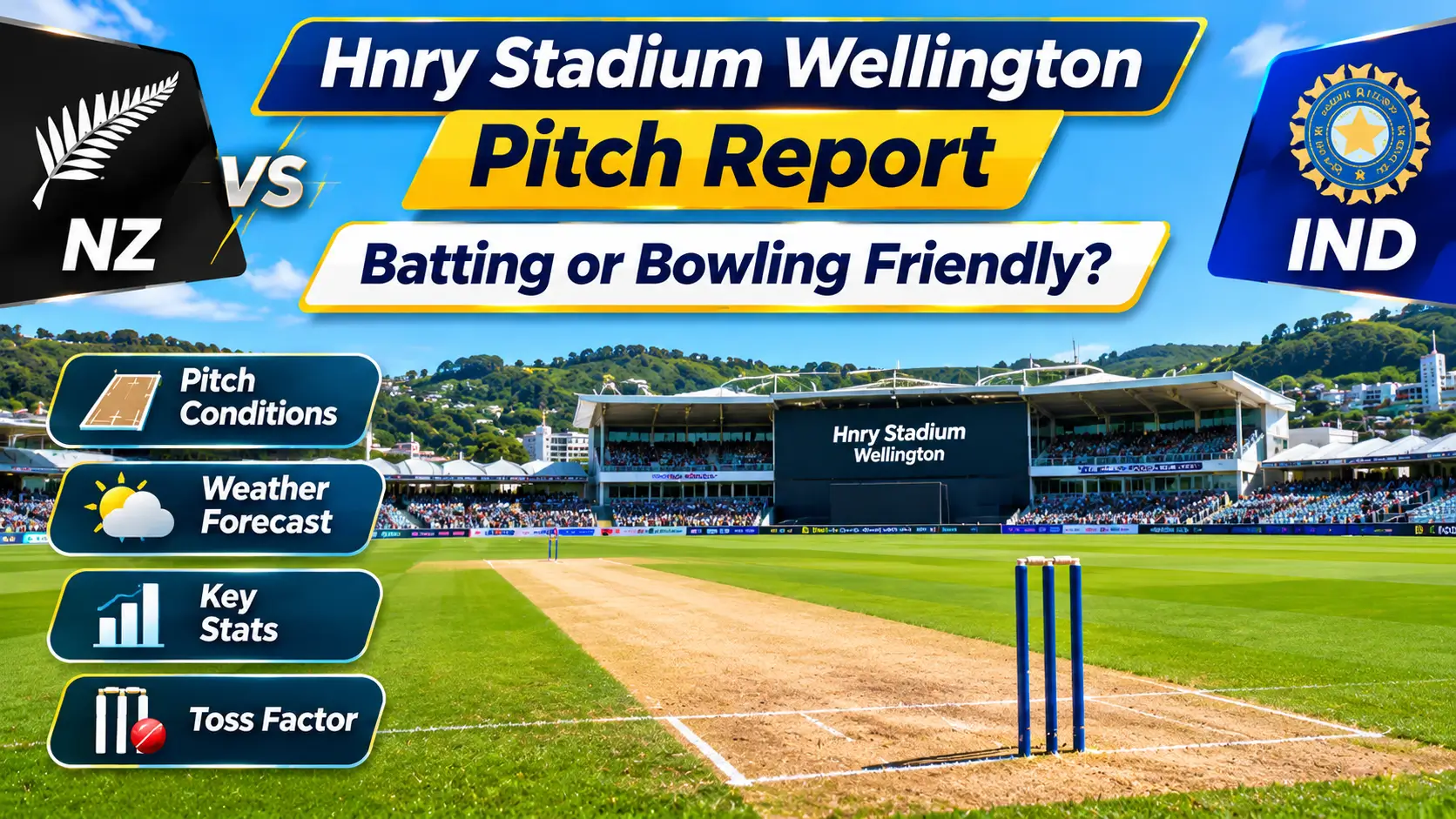
Hnry Stadium is a multipurpose arena that uses a drop-in cricket pitch. It has also been widely known as Sky Stadium and Westpac Stadium, and some match listings refer to it as Wellington Regional Stadium. Fans should not confuse this ground with the Basin Reserve, which is a separate cricket venue in Wellington and hosts a Test later in the same tour.
New-ball movement and pace bowling
The most interesting phase is likely to be the first ten overs. A fresh surface combined with cloud cover can encourage seam bowlers to maintain a full, challenging length and use the crease to attack both edges. The strength of that movement cannot be known until the actual strip is inspected. A green appearance alone is not proof of excessive seam or bounce; underlying moisture, hardness and preparation matter more.
Wellington’s coastal winds are another variable. Crosswinds can influence line, length and field placement, especially for bowlers attempting to swing the ball or deliver slower variations. A bowler who finds a stable release point may be more effective than someone relying only on speed. Captains may protect the short or wind-assisted side according to conditions on match day.
Middle overs and the role of spin
Spin should not be dismissed simply because the match is in New Zealand. On a firmer, drier track, wrist-spin can challenge batters with turn or bounce; finger-spinners can slow the scoring rate by changing pace and angles. Conversely, if wind and moisture favour seam, a side may choose extra fast-bowling coverage. Neither team should assume the pitch will behave identically for all 100 scheduled overs.
Batters who survive the new ball can look for easier scoring opportunities when the surface is truer and field restrictions change. Rotating strike is particularly important if boundary options are limited by the wind or longer square boundaries. India’s experienced middle order and New Zealand’s adaptable all-rounders could shape the contest between overs 15 and 40.
Death overs and chasing conditions
At the death, yorker execution, wide lines and slower balls can be valuable; there is no automatic guarantee that the ball will stop or skid. An evening shift in cloud, wind or moisture could also influence a chase. Captains therefore need to revisit their assumptions at the toss rather than deciding on a preferred innings purely from historical patterns.
Hnry Stadium ODI Records, Ground Dimensions and Scoring Context
The Wellington venue opened in 1999 and has a commonly cited capacity of approximately 37,000 with temporary seating. Its ends are identified as the Scoreboard End and City End. The oval’s distinctive shape has earned it the nickname “Cake Tin.” The ground hosts multiple sports, so the cricket boundary layout can vary; a single fixed boundary distance is not reliable without match-specific measurements.
Published record summaries sometimes mix ODIs, T20Is and women’s matches, producing misleading averages. For an ODI pitch report, only men’s ODIs should be used when claiming a historical first-innings average or win percentage. Without a consistent, independently checked match-by-match ODI dataset for the same venue designation, this article does not present a precise all-time ODI average as a verified fact.
| Ground information | What it means for the preview |
|---|---|
| Opened in 1999 | Established international multi-sport venue |
| Approx. 37,000 capacity | Temporary seating can affect the stated maximum |
| Drop-in pitch | Behaviour depends on preparation and underlying conditions |
| Scoreboard End / City End | Useful reference points for bowling and field positions |
| Coastal Wellington setting | Wind direction and gusts can influence tactics |
| Previous ODI: NZ v England, November 2025 | Historical context, not a direct forecast for this strip |
As a recent ODI example, New Zealand defended 226 for eight against England, who were dismissed for 222, at the venue on 1 November 2025. One close-scoring contest illustrates how competitive a total in the low 200s can be, but it cannot establish a permanent par score. Surface variation and changing weather make an exact “winning total” premature.
Instead of inventing an average, consider three match scenarios. On a difficult surface, preserving wickets may make even a relatively modest total competitive. On a good batting pitch, a side could push past 280 if the middle order capitalises. If showers shorten the contest, DLS targets and the number of overs available will matter more than a speculative full-innings score.
Wellington Weather Forecast for 7 November 2026
Available forecasts checked on 5 November indicate a cool, cloudy match day with some risk of patchy rain. A Wellington forecast lists temperatures near 17°C around the afternoon and around 16°C in the early evening, with northerly winds around 18–23 km/h and stronger gusts possible. The same forecast suggests that the 2 PM and 5 PM periods may be overcast rather than continuously rainy.
There is uncertainty: other forecast models show showers closer to the match window, so readers should not treat an early forecast as a rain-delay prediction. In coastal cities, showers can arrive or disappear faster than a two-day forecast suggests. The official toss time, ground inspection and radar observations are the reliable checkpoints on match day.
| Period (local) | Indicative conditions | Cricket implications |
|---|---|---|
| Morning | Cool, cloudy; possible patchy showers | Surface and outfield moisture worth monitoring |
| 2–3 PM | About 17°C; cloud cover; northerly wind | New-ball movement is a possibility |
| 5–6 PM | About 16°C; mainly cloudy in one forecast | Wind and visibility may affect execution |
| Evening | Cool conditions; variable shower risk | Check DLS implications if play is interrupted |
Temperatures, wind speeds and rain probabilities are forecast estimates rather than observations. If the match is delayed, a shortened chase can require a different approach: preserving wickets, reading the DLS par score and recognising which bowlers can complete their adjusted allocation. The first ODI has already reminded both teams that weather can become a tactical factor.
Will rain interrupt the second ODI?
A rain interruption is possible but not inevitable. The forecasts do not justify declaring a washout, and there is enough disagreement between services to avoid a precise claim. Fans should follow updated hourly forecasts, ground reports and the match officials’ announcements on 7 November.
Toss Prediction and Expected First-Innings Approach
Bowling first may appeal to a captain if early cloud and a fresh strip promise assistance for seamers. The chasing captain would also gain clearer information about an adjusted DLS target if rain changes the contest. However, a forecast does not give either captain certainty about the pace of the wicket or the direction of the wind in the evening.
Batting first remains defensible when the pitch looks hard and consistent. Runs on the board create pressure, particularly if spin becomes more useful in the second innings or if visibility worsens under lights. A disciplined batting unit can use the powerplay cautiously before expanding during overs 20 to 40.
India should avoid letting the 1–0 lead dictate a conservative selection. New Zealand should not overreact to the first game’s batting collapse by assuming Wellington will be similarly difficult. The toss is best analysed alongside the final XI and pitch report, not treated as a prediction of the winner.
What is a competitive total?
It is better to think in ranges of conditions than one invented venue average. On a bowling-friendly deck, a well-managed 230–250 could demand serious work from the chasing side. On a flat surface, even 280 may not be enough. These are illustrative tactical scenarios, not statistical predictions or verified historical averages for Hnry Stadium.
India and New Zealand Squads, Fitness Updates and Predicted XIs

Both countries announced phase-specific ODI squads, and several injury updates changed the original groups. For readers comparing squad announcements with earlier lists, the India vs New Zealand ODI squad 2026 breakdown explains the captaincy split, player availability and full series schedule. The second ODI belongs to the opening three-match squad phase.
India are led by Shubman Gill for this ODI, with Shreyas Iyer listed as vice-captain. Nitish Kumar Reddy was selected only for the first ODI, making it incorrect to carry him automatically into the Wellington XI. Prasidh Krishna was ruled out and Auqib Nabi was subsequently added. New Zealand captain Mitchell Santner leads a group reshaped by injury withdrawals involving Rachin Ravindra and Mark Chapman.
India — opening ODI group
Nitish Kumar Reddy was available only for ODI 1, not this match.
New Zealand — opening ODI group
*Fitness or match-day availability requires a final check. Conway missed ODI 1 following concussion.
India predicted XI — provisional
Shubman Gill (captain), Rohit Sharma, Virat Kohli, Shreyas Iyer, KL Rahul (wicketkeeper), Naman Dhir, Axar Patel, Anshul Kamboj, Arshdeep Singh, Gurnoor Brar and Kuldeep Yadav.
This projection gives India three genuine pace options, an additional batting option and wrist-spin variety. Mohammed Siraj, Auqib Nabi or Ishan Kishan could enter depending on how management interprets the strip and team balance. The prediction is based on known availability and the Auckland combination rather than a confirmed selection announcement.
New Zealand predicted XI — provisional
Will Young, Tim Seifert, Henry Nicholls, Daryl Mitchell, Tom Latham (wicketkeeper), Glenn Phillips, Michael Bracewell, Mitchell Santner (captain), Nathan Smith, Jacob Duffy and Blair Tickner.
That combination is a working scenario if Conway and Matt Henry remain unavailable. Should either be declared fit, New Zealand could change the opening order or pace department. Conditions may also encourage the management to examine Kyle Jamieson. No predicted XI should be labelled final until the toss.
Selection questions worth watching
India must judge whether Kohli’s aggressive Auckland approach needs extra top-order protection against a swinging new ball. New Zealand face a different challenge: rebuilding batting confidence without sacrificing too much bowling depth. Both teams have wicketkeeping alternatives, but each choice changes how many specialists can be selected elsewhere.
Key Players, Tactical Matchups and Match Prediction
Virat Kohli arrives after a rapid 74 in the opener, making his control against full-length seam bowling an obvious talking point. If the ball moves, his decision-making outside off stump will be more significant than his scoring rate in Auckland. Gill and Rohit offer different top-order methods: one can absorb pressure while the other can change the field quickly through boundary strokes.
For New Zealand, Tim Seifert’s 38 in Auckland was a useful contribution in a struggling innings. Daryl Mitchell and Glenn Phillips bring contrasting strengths through the middle. Santner and Bracewell are valuable because their all-round skills provide flexibility regardless of whether the pitch favours movement or becomes slower.
Arshdeep Singh’s four wickets in the first ODI show how damaging his angles can be, but a repeat is not guaranteed. Anshul Kamboj was notably economical in Auckland and may again suit a disciplined new-ball plan. New Zealand’s Jacob Duffy has the ability to challenge India’s top order with upright seam, while Nathan Smith offers another change of angle and length.
| Matchup | Why it matters |
|---|---|
| Kohli vs NZ seamers | Testing technique through the first spell and transition to the middle overs |
| Gill/Rohit vs Duffy | Managing the new ball and avoiding an early cluster of wickets |
| Seifert vs Arshdeep | Left-arm angles against an attacking top-order batter |
| Santner/Bracewell vs India middle order | Controlling tempo if the pitch offers grip |
| India pace attack vs Mitchell/Phillips | Stopping a counterattack before the last ten overs |
Match assessment: India have the immediate advantage of a series lead and a strong first-ODI bowling performance. New Zealand benefit from home familiarity and have a genuine route back through early wickets and tighter middle-overs bowling. Forecast uncertainty makes a confident winner prediction unjustified: the toss, inspected pitch and final teams should have more weight than narrative momentum alone.
Official match scheduling and venue details can be checked through the BCCI’s second ODI match centre. Recheck the same source near the toss for the final playing elevens and any last-minute adjustments.
NZ vs IND 2nd ODI Pitch Report: Frequently Asked Questions
Where is the NZ vs IND 2nd ODI being played?
The second ODI is scheduled at Hnry Stadium in Wellington, also known as Sky Stadium or Wellington Regional Stadium. It is not the Basin Reserve, which is a separate Wellington venue.
What time does the second ODI start in India?
The scheduled start is 7:30 AM IST on Saturday, 7 November 2026. That corresponds to 3:00 PM local New Zealand time.
Is the Wellington pitch better for batting or bowling?
The drop-in pitch can offer seam movement early depending on moisture and cloud, but conditions may become more balanced later. A final call requires the match-day surface inspection.
Will rain affect the NZ vs IND match?
Available forecasts suggest cloud with a possibility of showers, but do not confirm any interruption. Fans should check updated hourly weather and official match announcements.
What is the expected first-innings score?
There is no dependable single total without inspecting the pitch. Totals around 230–250 could be competitive in bowling-friendly conditions, while a flatter track could require considerably more.
Who are the captains and are the playing XIs confirmed?
Shubman Gill and Mitchell Santner captain the current ODI squads. The XIs in this preview are predictions, not confirmed teams; the official lineups are announced at the toss.
Conclusion: What to Expect in Wellington
The NZ vs IND 2nd ODI pitch report is defined by three connected uncertainties: how the Hnry Stadium drop-in strip plays in the first ten overs, whether Wellington’s clouds and wind help the seamers, and whether showers alter the innings. India start ahead in the series, but New Zealand can make the contest far more difficult through disciplined opening spells and sensible batting partnerships.
For the most accurate pre-match reading, compare the pitch appearance with the toss decision and final XI rather than relying on generic venue labels. This article will need a match-day update for confirmed players, weather observations and any changes to the scheduled start. Until then, a balanced contest with early pace assistance is a reasoned possibility—not a guaranteed outcome.